
Invisibility vs. Fame; You won't believe what the biggest secret of all may be.

I would rather be invisible than famous.
That probably sounds strange coming from someone who has spent so much time around modeling, pageantry, entertainment, talent, photography, events, and people who dream about being seen. We live in a time when visibility has become almost a currency of its own. People count followers, views, likes, shares, comments, and subscribers. Children grow up watching other children become famous online. Teenagers can become recognizable overnight. Entire careers can begin with one video that catches the right attention at the right moment. And yet, the older I get, the more I understand that being seen and being successful are not necessarily the same thing.
Fame has never interested me as much as being useful. I would much rather be the person who knows how to create something, solve something, organize something, build something, or make something better than be the person everyone recognizes when I walk into a room. There is something powerful about being known for what you can do rather than simply being known.

When we look at the entertainment industry from the outside, our eyes naturally go to the person in front. We see the actor, the singer, the model, the television personality, the influencer, or the person walking the red carpet. That is where the camera is pointed, so it is easy to assume that is where all the important work is happening. It is not.
Behind nearly every person the public recognizes is a group of people the public may never know. Someone chose the clothing. Someone created the hair and makeup. Someone planned the shoot. Someone found the location. Someone adjusted the lights. Someone held the camera. Someone booked the talent. Someone wrote the script. Someone coached the performance. Someone edited the footage. Someone handled the sound. Someone negotiated the agreement. Someone organized the schedule. Someone made sure everybody arrived where they were supposed to be at the time they were supposed to be there. Then, when everything is finished, the audience sees one person.
I have always found that fascinating.
The person receiving the applause may be only one part of the story.
I think young people need to understand that because so many of them are introduced to entertainment through fame. They see the finished product. They see the celebrity. They see the awards, the photographs, the followers, the beautiful clothes, the premieres, and the attention. They rarely see the work happening twenty feet away from the camera.
So when a child says, “I want to be famous,” I think there is another question worth asking.
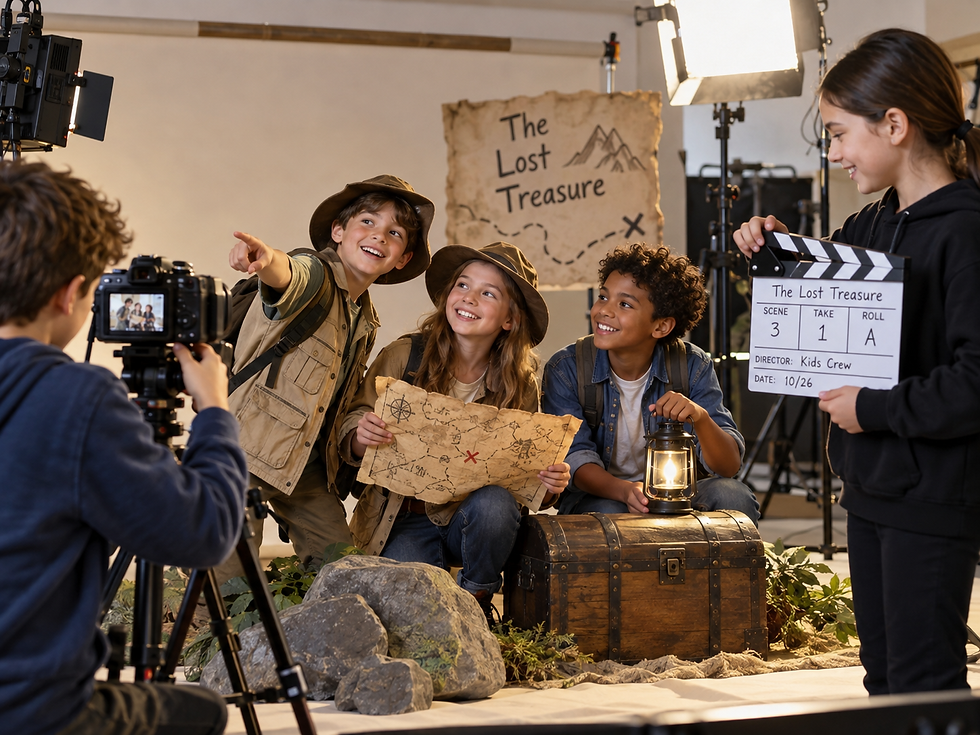
What part of being famous do you actually want?
Do you love acting?
Do you love singing?
Do you love modeling?
Do you love performing for people?
Or do you simply love what fame appears to represent?
Those are not all the same thing.
Sometimes a child believes she wants to be a model until she steps onto a photoshoot and becomes more interested in the person holding the camera. She starts watching the photographer move around the room, change lenses, adjust the light, and completely transform an ordinary moment into an extraordinary image. Another child may think she wants to act until she gets backstage and discovers hair and makeup. Suddenly she is fascinated by brushes, colors, products, transformations, and the way a completely different look can help create a character. Someone else may attend a fashion show and barely watch the runway because she is interested in what is happening behind the curtain. Who decided which model wore which outfit? Who organized the order? Who chose the music? Who made sure everyone was ready? That tells you something. Sometimes a future career reveals itself through what a young person cannot stop paying attention to. I think that is why exposure matters so much. A child cannot dream about a career she does not know exists.
If all we ever show young people is the person standing in front of the camera, we should not be surprised when they believe that is the only place worth standing.
But entertainment is much bigger than that.
There are photographers, videographers, casting professionals, producers, directors, editors, writers, stylists, wardrobe professionals, choreographers, agents, managers, publicists, graphic designers, makeup artists, hairstylists, sound engineers, lighting
technicians, set designers, event producers, creative directors, social media managers, talent coordinators, and people doing jobs most children have never even heard of.

Many of those people work with celebrities every day. Most of them can still go to the grocery store without anyone noticing. That sounds like a pretty good arrangement to me.
The truth is, I would much rather be invisible to the public and indispensable to the people I work with. There is a tremendous difference between someone saying, “I recognize you,” and someone saying, “Call her. She knows exactly what she is doing.” The second one interests me far more.
A reputation is different from fame. Fame means many people know your name.
A reputation means the right people know your work. A person with a strong reputation may never have millions of followers, but they may never have to worry about whether people in their industry understand their value. Their work speaks before they enter the room.
That kind of recognition is earned differently.
It comes from developing a skill well enough that other people trust you with something important. It comes from becoming the person who can solve the problem nobody else knows how to fix. Entertainment needs those people desperately.
A production can survive without fame.
It cannot survive without people who know what they are doing.
Remove the person controlling the sound and suddenly everyone notices.

Remove the person handling lighting and the beautiful scene no longer looks beautiful.
Remove the stylist and the entire visual direction can change.
Remove the editor and hours of footage remain nothing more than hours of footage.
Remove the producer and everyone may discover very quickly how much organization was happening behind the scenes. Those people may not be famous, but they are not unimportant. In many situations, they are essential. That is another reason I think we have to broaden the way we talk to children about entertainment careers.
We spend so much time asking, “Do you want to be a model?” or “Do you want to be an actor?” that we miss the opportunity to ask something much more interesting.
What do you notice? When you watch a movie, what are you paying attention to?
When you look at a magazine, are you looking at the model or wondering how the

photograph was created? When you watch a concert, are you watching the performer or studying the stage, lights, sound, costumes, and choreography? When you see a commercial, are you interested in the actor or wondering why the commercial made you feel something? When you scroll through social media, are you paying attention to the person or wondering how the video was filmed and edited? Those answers may tell you more about a young person than asking what she wants to be when she grows up. I also think there is something healthy about teaching young people that fame is not the only measurement of success. Fame is unpredictable.
You can be extraordinarily talented and never become famous.
You can work hard and never become famous.
You can make every right decision and still never become famous.
There are too many factors outside your control.
But skill, knowledge, experience, professionalism, reputation are all things you can build.
Those things give a young person something solid to stand on.
That is why I would rather teach someone how the business works than simply tell them how to get noticed. Getting noticed can happen quickly.
Knowing what to do after someone notices you is another matter entirely.
That is where preparation becomes important.
A young person who understands both sides of the camera becomes more valuable. A model who understands photography begins to understand light, angles, movement, and

why a photographer may ask for something specific. An actor who understands production begins to appreciate timing, continuity, marks, sound, and why a scene may need to be repeated again and again. A content creator who understands editing begins to shoot differently. A performer who understands wardrobe begins to understand why clothing can completely change how something reads on camera. A young person who understands the entire process begins to see the entertainment industry not as one narrow road to fame, but as an enormous collection of possibilities. That is the part I find exciting.
Changing direction does not mean the first dream failed.
Sometimes it means you finally discovered the right one.
That is one of the ideas I want I’m In The Spotlight to represent.
I do not want young people to believe there is only one valuable place in entertainment, standing underneath the brightest light in the room.
I want them to understand the entire room, what happens before the model walks onto the set, what happens after the actor finishes the scene.
I want them to see the people standing just outside the frame. I want them to realize that some of the most interesting careers in entertainment belong to people whose names may never appear in giant letters.

If a young person can learn that early, I think we have given them something much more valuable than a lesson in how to become famous. In some instances they can be both. And that is where Im in the spotlight will come in handy we won't only teach the fame part we will help each student understand all aspects giving them a much more lucrative stance in the field. @iminthespotlight.com


Comments